After-Hours Maintenance Calls: How to Triage Without Burning Out Your Team
Most night calls aren’t emergencies, but every one of them wakes someone up. Here’s how to sort them fast, protect your on-call people, and still catch the real emergencies.

Quick answer
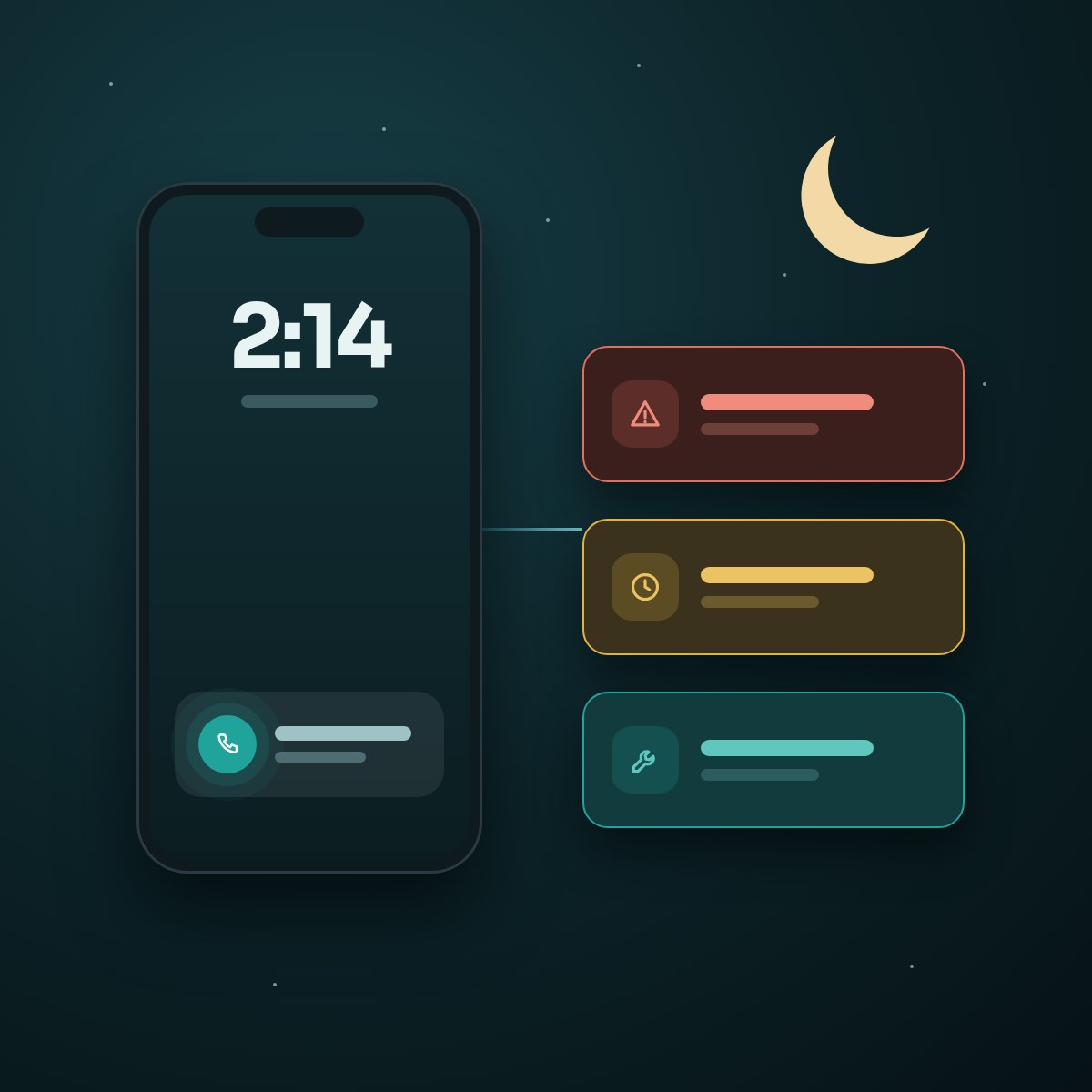
Triage every after-hours call the same way: safety questions first, then whether the tenant can stop the damage, then a clear category. Real emergencies (fire, gas, carbon monoxide, flooding, no heat in freezing weather) go to your on-call person and vendor now. Everything else becomes a work order for the morning.
Key takeaways
- Write down what counts as an emergency, and put the same definition in your lease, tenant portal and call script.
- Ask safety questions first. Gas, smoke or a carbon monoxide alarm means the tenant leaves and calls 911 or the utility.
- Only true emergencies should wake your on-call person. Urgent and routine calls become work orders for the morning.
- Rotate on-call weekly with a named backup, and pre-approve vendor spending limits so nobody negotiates at 2 a.m.
- AI can answer every call and do the sorting, so people only get woken up when it matters.
The phone rings at 2:14 a.m. It might be a burst pipe. It might be a dripping faucet. Whoever is on call has to wake up, listen and decide, and they’ll do it again tomorrow night.
Done badly, after-hours maintenance burns out your best people and runs up emergency vendor bills. Done well, it protects tenants, owners’ properties and your team’s sleep. This guide covers the triage rules, the call flow and the on-call setup that make the difference.
Why do after-hours maintenance calls burn out property management teams?
Because every call wakes someone up, and most of them could have waited until morning. A running toilet, a dishwasher that won’t drain or a question about trash day all ring the same phone as a burst pipe.
The on-call person pays twice: broken sleep tonight and a slower, crankier day tomorrow. Over months, that’s how good maintenance coordinators quit. Owners pay too, when a non-emergency gets an after-hours vendor at emergency rates because nobody had a clear rule to say “this can wait.”
The fix isn’t answering fewer calls. Tenants need a reliable way to reach you at any hour. The fix is sorting calls consistently, so only the real emergencies reach a person at night.
What counts as a maintenance emergency?
An emergency threatens someone’s safety, is causing damage right now, or leaves the home unlivable. Everything else can wait for business hours. Write your definitions down and use the same ones everywhere: your lease, tenant portal, website and call script.
| Level | Examples | Response |
|---|---|---|
| Emergency | Fire or smoke, gas smell, carbon monoxide alarm, flooding or a leak the tenant can’t stop, sewage backup, no heat in freezing weather, no power to the whole unit, a broken exterior door or window that won’t lock | On-call person and vendor now |
| Urgent | No hot water, refrigerator out, the only toilet clogged, AC out in extreme heat, a slow leak that’s been contained | First thing next business morning |
| Routine | Dripping faucet, appliance noise, running toilet, a light fixture out, a stuck window | Work order, scheduled normally |
Adjust the list for your climate and your local codes. Some cities define heat, hot water and working locks as habitability requirements with set response times, so check yours and follow the stricter rule.
How should an after-hours triage call go?
The same five steps, in the same order, every time. A consistent script is what lets a less experienced person, or an AI agent, make the right call at 2 a.m.
1. Safety first
Ask about smoke, fire, gas smell and carbon monoxide alarms before anything else. If the answer is yes, the tenant leaves the home and calls 911 or the gas utility first, then you. The CDC calls carbon monoxide an odorless, colorless gas that kills without warning, which is why an alarm is never a “check it in the morning” call.
2. Can the tenant stop the damage?
Walk them to the water shutoff or the breaker panel. A leak that’s stopped is no longer an emergency, and a calm tenant who knows where the valve is saves the owner thousands.
3. Classify it
Use your written definitions: emergency, urgent or routine. When the caller is unsure, ask for a photo or a short video.
4. Route it
Emergencies go to the on-call person and the after-hours vendor. Urgent and routine calls become work orders in the morning queue, with the details and photos attached.
5. Tell the tenant what happens next
Say exactly who will contact them and when: “A plumber will call you within the hour,” or “Our team will call you by 10 a.m.” Most repeat calls happen because nobody said what comes next.

What should tenants know before the first after-hours call?
The best emergency call is the one a tenant can handle in the first two minutes. Cover these at move-in and repeat them in your portal and welcome email:
- Where the main water shutoff and each fixture’s shutoff valve are.
- Where the breaker panel is, and how to reset a tripped breaker.
- Your written list of what counts as an emergency, and the one number to call.
- When to call 911 or the gas utility before calling you.
- How to send photos or video with a request.
How do you set up an on-call rotation people can live with?
Make it predictable, shared and rare. On-call is sustainable when it’s fair, when it’s backed up, and when the phone only rings for real emergencies.
- Rotate weekly, with a named backup who answers if the primary misses the call.
- Wake people for emergencies only. Everything else waits for the morning queue.
- Pre-approve vendor spending limits for emergencies, so the on-call person can dispatch without calling the owner at 3 a.m.
- Keep a short list of after-hours vendors who have agreed to respond, with their numbers in one place. The Vendor Compliance workflow in PMP Workflows keeps their insurance and licenses current.
- Compensate it: a stipend, comp time or both. Unpaid on-call is the fastest way to lose people.
- Review every week: how many calls came in, how many woke someone, and which ones didn’t need to.
How can AI take the first after-hours call?
AI can answer every call, ask the safety questions, sort it and open the work order, so a person only gets woken up for a real emergency. That’s the whole triage flow above, run the same way at 2 a.m. as at 2 p.m.
With PMP Maintenance, AI voice agents answer tenant calls and texts 24/7. The AI Triage Center works through each request, sorts it by category and urgency, and sets up the work order with the details and photos. Emergencies reach your on-call person right away. Everything else is waiting in the morning queue. Any spending still waits for a property manager’s approval.
See how it works step by step in What Is AI Maintenance Triage?.
How do you know your after-hours process is working?
Track a few numbers every month and watch the trend.
- After-hours calls per 100 doors, and how many were true emergencies.
- How many calls woke the on-call person, and how many of those could have waited.
- After-hours vendor dispatches and what they cost the owners.
- Time from the first call to a confirmed response for emergencies.
- Tenant feedback on after-hours service, and on-call staff turnover.
If the share of calls that wake someone keeps falling while emergency response time holds steady, your triage is doing its job.
Frequently asked questions
What is considered a maintenance emergency in a rental?
Anything that threatens safety, is causing damage right now, or leaves the home unlivable: fire or smoke, a gas smell, a carbon monoxide alarm, flooding, sewage backup, no heat in freezing weather, no power, or an exterior door that won’t lock. Check your local codes for additions.
Should tenants call 911 before calling the property manager?
Yes, for fire, smoke, a gas smell or a carbon monoxide alarm. They should leave the home and call 911 or the gas utility first, then call you. Put that instruction in your lease and tenant portal.
Do I still need an on-call person if AI answers after-hours calls?
Yes. AI can answer, ask the safety questions and sort every call, but a person should still handle true emergencies and approve any spending. The difference is that the phone only rings for the calls that need them.
How do I stop non-emergency calls at night?
Give tenants a written emergency list, a clear way to submit routine requests any time, and a confirmation of when routine work will happen. Most non-emergency night calls come from tenants who aren’t sure anyone heard them.
Sources
Sleep through the routine calls
Want every after-hours call answered without waking your team?
Book a call and we’ll show you how PMP Maintenance answers, triages and routes after-hours requests for your portfolio.
Keep reading
Related resources
What Is AI Maintenance Triage?
An Article Brief on how PMP answers maintenance calls with AI voice agents, triages them by category and urgency, and sets up the work order.
Kevin Wall3 min read
How to Use AI to Save Time in Property Management (With Prompts)
The tasks to hand to an AI assistant first, a five-part prompt recipe, six prompts you can copy today, and what never to paste in.
Kevin Wall7 min read
AI for Tenant Communication: Faster Replies That Don’t Sound Like a Robot
Which tenant messages AI can answer, how to keep replies sounding like your team, and what AI should never send on its own.
Kevin Wall6 min read