How Do Landlords Find Property Management Companies in Your City?
They still go to Google. They type “property management” and your city, and Google shows them three companies next to a map. Everyone else is one click further away.


Quick answer
Most landlords find a property management company on Google. They search “property management” plus their city, and Google shows three local companies next to a map, with everyone else hidden behind a More businesses button. Those three get most of the calls, and those calls are high-intent leads: owners in your area who are ready to hire.
Key takeaways
- Landlords still start on Google, with searches like “property management [your city].”
- Google shows three companies next to a map. Everyone else sits behind the More businesses button.
- The top three get most of the owner calls from those searches.
- Those are high-intent leads: owners in your area, looking to hire right now.
- Getting into the top three starts with knowing where you rank today and what’s holding you back.
Ask a rental owner how they found their property manager and the answer is usually the same: they searched Google. Even with referrals, AI assistants and social media, most owners who are ready to hire still open a search bar and type what they need.
What happens next decides which companies get the call. This guide walks through exactly what a landlord sees, why only three companies get most of the attention, and what you can do to be one of them.
Where do landlords look for a property management company?
They still go to Google. When an owner decides it’s time to hand over a rental, the first step for most of them is a search. It’s fast, it’s local, and it shows them real companies with reviews, hours and a phone number in one place.
Referrals still matter, and more owners are asking AI assistants for recommendations too. But even an owner who got a name from a friend usually searches it before calling, which means your Google presence is part of almost every decision. (For the AI side, see What Is AEO?.)
What do landlords type into Google?
Short, local searches that say exactly what they want. Most owners don’t search for your company by name. They search for the service and the place:
- “property management [your city]”
- “property management near me”
- “property management company [your city]”
- “property manager for rental homes [your city]”
- “[neighborhood] property management”
Every one of these searches has local intent. Google reads it as “show me businesses near here that do this,” and it answers with a map.
What does Google show them?
Local results next to a map: three companies, and a button for everyone else. Here’s a live result for “property management abilene.” Three companies are listed with their ratings, hours and phone numbers. Every other property manager in the city is hidden behind the More businesses button.
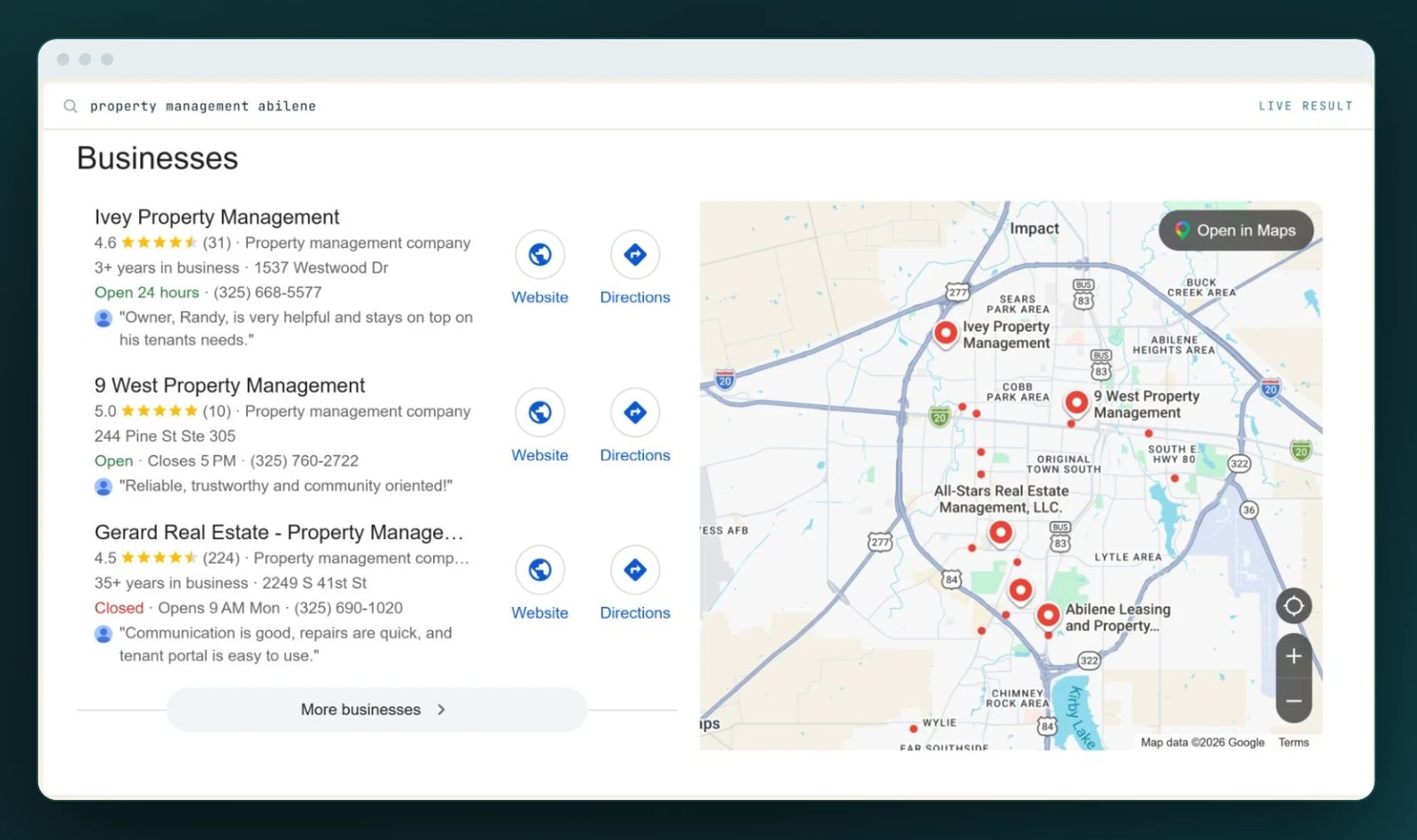
Each listing gives an owner a quick read on the company: the star rating and number of reviews, the business category, years in business, whether it’s open right now, a phone number and a snippet from a real review. Owners compare those three at a glance, and the one that looks most established and most responsive usually gets the first call.
There may be dozens of companies managing rentals in that city. From the owner’s point of view, there are three. Results also change with where the searcher is standing, so the same search across town can show a different three.
Who gets the calls from those searches?
The three companies in the top three get most of them. Most owners never click More businesses. They look at the three companies in front of them, compare stars and reviews, and call one of them. For the companies in those spots, that’s a steady flow of leads they don’t pay per click for.
Why so few clicks on More businesses? Because the owner already has three credible options in front of them, each with reviews, a phone number and directions. Clicking through to a longer list is extra work, and most people only do it when the first three look wrong for them. If you’re not in the three, you’re counting on the owner to go looking for you.
And they aren’t just any leads. That’s what makes the top three so valuable.
The top three don’t just get more leads. They get the most valuable lead your business can get.
What is a high-intent lead, and why is it worth so much?
A high-intent lead is a customer who is looking to hire right now. For a property management company, it’s a property owner, in your location, looking for help. They aren’t browsing or curious. They searched because they’ve decided to hire someone.
| Where the lead comes from | What the owner is doing | Intent |
|---|---|---|
| A “property management [city]” search | Choosing a manager to call today | High |
| A referral from a friend or agent | Checking out a name they were given | High |
| A reply to a mailer | Thinking about it for later | Medium |
| A click on a social media post | Curious, not yet shopping | Low |
In other words, a top-three search result delivers the most valuable lead for your business, at the exact moment the owner is ready. That’s why the top three is worth fighting for, and why the next step is knowing where you stand.
What decides which companies make the top three?
Google looks at three things: relevance, distance and prominence. It explains this in its own Business Profile help pages.
- Relevance: how well your Google Business Profile and website match the search, starting with your primary category and the services and areas you describe.
- Distance: how close your business is to the person searching. You can’t move your office, but a stronger profile reaches farther.
- Prominence: how established you look online and off, including the number and freshness of your reviews, links from other sites and consistent business details.
The companies in the top three aren’t always the biggest or the oldest. They’re the ones Google is most confident about for that search, from that spot.
How do you get your company into the top three?
Start by finding out where you rank today and what’s keeping you out. Watch this short video. It explains what owners see and what you should do next.
Then enter your property management company on our free local search report. You’ll see where you rank on Google Maps, the gaps between your website and your Google Business Profile, and what to fix to move into the top three.
For the full picture of how Google chooses those three companies, read Why Do Other Property Managers Rank Higher in the Google Map Pack?, and use our local ranking check any time you want a quick look at your visibility.
Frequently asked questions
Why does Google show only three property management companies?
For local searches, Google shows a short list of businesses next to a map, usually three, and puts the rest behind a More businesses link. It picks those three based on how relevant each business is to the search, how close it is to the person searching, and how established it looks online, including reviews.
Can I pay Google to be in the top three?
Not in the regular map results. Google says there’s no way to request or pay for a better local ranking. You can buy ads that appear above or alongside the map results, but they’re labeled as sponsored. The unpaid top three is earned through your Google Business Profile, your website and your reviews.
Does everyone see the same top three?
No. Results change with where the person searching is standing, so an owner across town can see a different three companies than an owner near your office. That’s why it helps to check your ranking at several points across your market instead of searching only from your desk.
How long does it take to get into the top three?
It depends on your market and on how far you are from the companies ahead of you. Fixes like your business category, hours and consistent business details can help quickly, while reviews and local links build over months. Start with a report that shows where you rank today and what’s holding you back.
Sources
Be one of the three
Want owners in your city to find you first?
We’ll show you where you rank today, why, and what it takes to get into the top three on Google Maps.
Keep reading
Related resources
Why Do Other Property Managers Rank Higher in the Google Map Pack?
Google shows three property managers at the top of a local search. How relevance, distance and prominence decide who they are, and what to fix first.
Kevin Wall9 min read
Speed to Lead: How Fast Should Property Managers Answer Owners?
An owner who fills out your form is often talking to other managers too. What the research says, the standard to set, and how to hit it.
Kevin Wall6 min read