Why Do Other Property Managers Rank Higher in the Google Map Pack?
Google shows three property management companies at the top of a local search, and those three get the calls. Here’s how Google picks them, and how to become one of them.


Quick answer
Google ranks property management companies in the Map Pack on three factors: relevance, distance and prominence. Relevance is how well your Google Business Profile and website match the search. Distance is how close you are to the searcher. Prominence is how established you look, based on reviews, links and listings. Find the factor you’re losing on and fix it first.
Key takeaways
- Google shows three companies in the Map Pack. Everyone else is hidden under the “More businesses” button.
- Google ranks local results on relevance, distance and prominence, and says so in its own help pages.
- Your primary Business Profile category and your website’s service and city pages drive relevance.
- A steady flow of new reviews does more than a large total that stopped growing.
- You can’t pay Google for a better organic Map Pack position, but you can earn one.
Search “property management near me” from your office right now. There are likely dozens of companies in your market that manage rentals, but Google shows only three of them in the Map Pack at the top of the page. If yours isn’t one of them, you’re missing the most valuable real estate in local search: the spot where rental owners click when they’re ready to hand over their properties.
Most property managers assume the companies above them have more reviews, have been around longer or know some secret trick. Often none of that is true. Google ranks local businesses on three factors, and once you know which one you’re losing on, you know exactly what to fix.
What does the Map Pack look like for a property management search?
Three companies, a map and a button: that’s the whole first screen. Here’s a live example, a Map Pack for a “property management [city]” search. These three companies get the calls. Everybody else is hidden under the More businesses button, and most owners never click it.
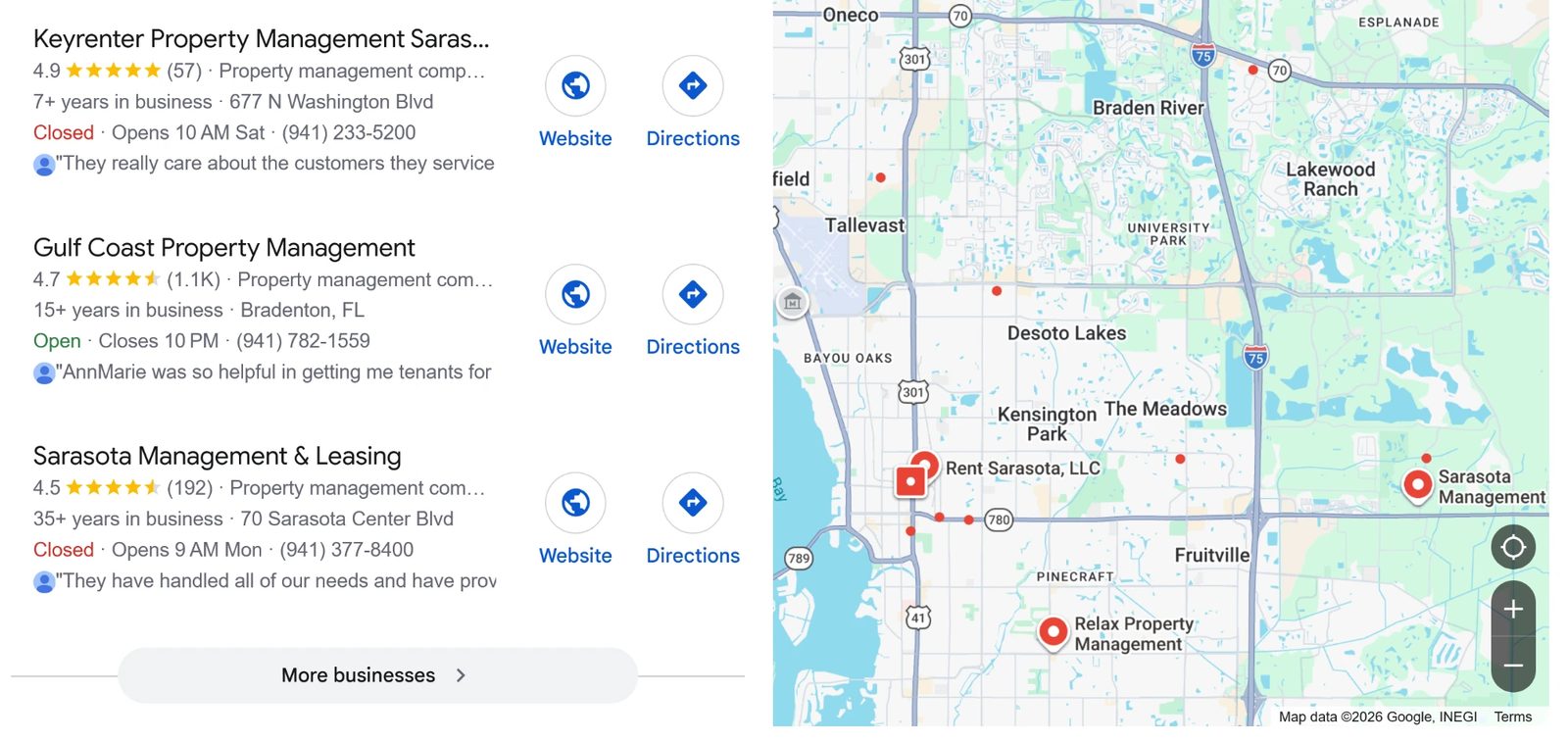
Now look at the review counts. The company listed first has 57 reviews. The one below it has more than 1,100, and the third has 192. If review count decided the order, this list would be upside down. Reviews matter, but they’re only one part of one factor, and the same search a few miles away can show a different three.
How does Google decide which property managers appear in the Map Pack?
Google ranks local businesses on three factors: relevance, distance and prominence. It says so in its own Business Profile help pages, and together the three decide who fills those spots.
| What it means | How much you control it | |
|---|---|---|
| Relevance | How well your Business Profile and website match what was searched | A lot: your category, your website’s pages, your business name |
| Distance | How close your business is to the person searching | Very little: you can only outgrow it |
| Prominence | How well known and trusted your business is, online and off | A lot, over time: reviews, links, consistent listings |
How do you convince Google you’re the answer to the search?
Match your Business Profile category, your website and your name to what owners search for. Relevance is the factor you control most, and it’s where many property management companies quietly lose.
Set the right primary category
Your Google Business Profile’s primary category is one of the most influential signals in local search. If property management is your core business, your primary category should be “Property management company.” A common mistake: brokerages with a property management division list “Real estate agency” as primary, then wonder why they never appear for property management searches. Add secondary categories only for services you actually provide.
Build a website that answers the search
Google reads your website to understand what you do and where you do it. Give each service its own page: single-family, multifamily, HOA, commercial, leasing-only and short-term rentals, if you offer them.
Then create useful pages for the cities and neighborhoods you serve: typical rents, local rental rules, the property types you manage there. Don’t copy one page and swap in town names; Google treats near-identical city pages as low quality.
Spell out what makes you different, too: fees, owner portal, guarantees, designations and owner reviews. Searchers look for these specifics, and AI search tools increasingly pull from them too.
Consider your business name
Having “Property Management” in your business name is a strong relevance signal. If your company is “Summit Group,” filing a legal DBA as “Summit Property Management” and using it everywhere can be a high-leverage move. Adding keywords to your Google profile name that aren’t part of your real business name breaks Google’s guidelines and invites suspension. A legitimate name change can also trigger re-verification.
Can you rank beyond the area around your office?
Yes, but only by getting stronger on relevance and prominence. Google weighs how close your business is to the searcher. You can’t move your office, but think of your ranking area as a radius around your address: the stronger your profile, the farther it reaches. That’s how a company across town can outrank firms that are physically closer to the searcher.
Be accurate about your address
If rental owners and tenants actually visit your office, show your address. If you run your company from home and don’t meet clients there, Google’s guidelines require you to hide your address and set a service area instead. Hidden-address profiles can still rank, because Google still uses your verified location behind the scenes. Showing a home address to gain ranking, or using a virtual office or mailbox, is a fast way to get suspended.
Expand with real locations only
A second office is a legitimate way to rank in a new market, as long as it’s a genuine, staffed location. Then a second Google Business Profile for that office makes sense.
How does Google judge how established your company is?
Through your reviews, links from other websites and consistent business details across the web. Prominence is Google’s read on how well known and trusted your business is, both online and off.
Review activity beats review count
A steady flow of new reviews signals an active, trusted business. A company with 800 reviews that mostly stopped coming in two years ago can lose ground to a competitor earning new reviews every week. The strongest approach is a built-in process that asks at the right moment, not an occasional push.
Earn local links
When reputable websites link to yours, Google sees your business as established. Property managers have natural opportunities many never use: investor and landlord associations, your NARPM chapter, the chamber of commerce and community sponsorships. You also have something local journalists want: rental market data. Commentary on local rents and vacancies can earn press links.
Keep your name, address and phone consistent
Your business name, address and phone number should match everywhere you’re listed: your website, Google, Yelp, the BBB and industry directories. Treat it as housekeeping: fix inconsistencies once and move on.
What do most property managers miss about Map Pack rankings?
Business hours, a split review audience, how they measure rankings, and competitors who break the rules. These four come up again and again with property management companies.
1. Your hours affect your rankings
Many property management firms keep limited office hours or never filled theirs in. If a rental owner searches at 5:45 p.m. and your profile says you closed at 5:00, a competitor listed as open may get the edge. Fill in complete hours and set holiday hours. Don’t list 24 hours just because you have an after-hours maintenance line; list when you’re actually available.
2. Two audiences share one review profile
Property management is unusual: the people who hire you (owners) and the people who review you most often (tenants) are different groups. Tenants often leave reviews after deposit disputes, rent increases or maintenance delays, while satisfied owners rarely think to leave one unprompted. Solve this deliberately by asking at natural high points:
- Owners: when you fill a vacancy quickly, after the first rent disbursement, or at an annual check-in.
- Tenants: after a smooth move-in, a fast repair or a lease renewal.
Then respond to every review, especially the negative ones. Keep responses calm and professional, never disclose a tenant’s personal details or lease terms, never touch on Fair Housing protected characteristics, and invite the reviewer to continue the conversation offline.
Prospective owners read your review responses to see how you handle conflict, because that’s exactly what they’re hiring you to do.
Stay within the rules, too. Don’t offer incentives for reviews, don’t ask only your happiest customers, and never post or buy fake reviews. The FTC’s rule on fake reviews lets it seek civil penalties against knowing violators.
3. Measure rankings the way Google sees them
Searching from your desk tells you little: you might rank first at your office and not appear two miles away. Geogrid tracking tools such as Local Falcon and BrightLocal check your ranking at dozens of points across your market and show the results as a map. Track your core searches monthly, such as “property management near me” and “property management company [city],” and watch where your radius grows. For a quick first look, run our free local ranking check.
4. Report competitors who break the rules
Sometimes the company above you ranks there because it’s cheating: keywords stuffed into the business name, a fake address or duplicate listings. You can suggest edits on their Google listing, and for serious or repeated violations Google provides a Business Redressal Complaint Form. Report only genuine violations, but removing a spammer can be the fastest ranking gain available.
How do you find out why a competitor outranks you?
Pick the company that keeps showing up above you and compare the three factors side by side. Whichever gap is widest is your plan.
| Factor | What to check on the competitor |
|---|---|
| Relevance | Their primary category, whether their name includes “property management,” and how well their website covers the services and areas you both compete for |
| Distance | Where their office sits relative to the searches you care about. If they’re simply closer, you’ll need to outgrow the gap on the other two factors. |
| Prominence | How recently and how often they get reviews, how they respond, and whether local organizations and news sites link to them |
Ranking in the Map Pack isn’t about finding the newest SEO trick. It’s about figuring out which of these three battles you’re losing and winning it deliberately, one improvement at a time.
Frequently asked questions
Why does a property management company with fewer reviews rank higher than mine?
Review count is only one part of prominence, and prominence is only one of three ranking factors. A competitor with fewer reviews may be closer to the searcher, have a better primary category, have “property management” in its name, or earn reviews more consistently.
Can a home-based property management company rank in Google Maps?
Yes. If you don’t meet clients at your address, Google requires you to hide it and list a service area instead, and hidden-address profiles can still rank in the Map Pack. Google still uses your verified address to measure distance. Never use a virtual office or mailbox address.
Do tenant reviews affect my property management company’s Google ranking?
Yes. Every Google review counts toward your prominence, whether it comes from a tenant or an owner. Ask both groups at positive moments, and respond professionally to every review, because prospective owners read your responses.
Can I pay Google to rank higher in the Map Pack?
No. Google states there’s no way to request or pay for a better local ranking. Paid options like Google Ads and Local Services Ads can place you above or alongside the Map Pack, but they’re labeled as sponsored and are separate from the organic map results.
Is it legal to offer incentives for Google reviews?
Offering rewards for positive reviews is prohibited under the FTC’s rule on consumer reviews, and Google’s policies prohibit incentivized reviews altogether. Buying fake reviews can lead to civil penalties. Ask every customer for honest feedback, not just your happiest ones.
Sources
- Google Business Profile Help: Tips to improve your local ranking on Google
- Google Business Profile Help: Guidelines for representing your business on Google
- Whitespark: Local Search Ranking Factors, 2026 edition (November 2025)
- Federal Trade Commission: Final rule banning fake reviews and testimonials (August 2024)
Win the Map Pack
Want to know which factor is holding you back?
We’ll look at your Google Business Profile, your website and the companies ranking above you, and tell you what to fix first.
Keep reading
Related resources
How Do Landlords Find Property Management Companies in Your City?
They still go to Google. What landlords search, what Google shows them, why the top 3 get the calls, and how to get into the top 3.
Kevin Wall6 min read
Speed to Lead: How Fast Should Property Managers Answer Owners?
An owner who fills out your form is often talking to other managers too. What the research says, the standard to set, and how to hit it.
Kevin Wall6 min read
AI for Property Management: How It Saves You Time and Money
Where AI actually saves hours in a property management company, what to automate first, where people stay in charge, and how to measure the savings.
Kevin Wall7 min read